
Indie Valley
Follow the builders whose numbers are real — and worth trusting
Indie Valley
Follow the builders whose numbers are real — and worth trusting
Pulse
Revenue is verified with a Paddle API key.Last updated: October 30, 2026
Story

Yes, we copied TrustMRR (but not exactly)
Well — a third of it. The story is worth telling properly, because the difference between the thirds is basically our whole thesis.
October 28, 2025. Pieter Levels tweets that the MRR screenshots in your feed are fake. Half a million views, because everyone knows he's right. 48 hours later Marc Lou ships TrustMRR — a leaderboard of startups with revenue verified through read-only payment APIs. Built in about a day, seeded with his own 8 products, $18k MRR within 5 days. One of the cleanest speed-runs this scene has ever seen.
Everyone saw the leaderboard. I couldn't stop looking at the business model. TrustMRR's revenue doesn't come from the product — it comes from the sponsor slots along the sides, $1.5k–2k a month each. What Marc actually monetized is his distribution: an X audience plus SEO, packaged into a page where you can rent a slice of his traffic. Around $35k a month as I write this — a number most SaaS never touch, generated by a catalog. Zero shade. It's a masterclass, and we studied it.
The part I didn't buy was the job. TrustMRR drifted from leaderboard to marketplace — the browser tab literally reads "Buy and Sell SaaS Startups" now. And a marketplace visit is transactional: you list your startup for sale, you leave, you come back the day a buyer knocks. The site claims 180k monthly visitors; almost all of it lands on the front page and leaves. Which is fine — for that job. Selling your startup is something you do once.
But look at what's sitting underneath that job. A read-only key to a payment processor. A number nobody can fake. Trust, manufactured at the source. And here's the actual lesson of this post, so let me say it plainly: a mechanic and a job are different things. Verified revenue is a mechanic. "Sell your startup" is a job. Marc bolted them together in 48 hours, and the speed hid the fact that they're separable — the same mechanic can carry other jobs, including jobs much deeper than the one it launched with.
Here's the job we transplanted it onto. A builder doesn't need to sell their company daily. What they need daily is different: to know what's actually working for people like them, to be seen doing real work, to not build alone. That's not a transaction — that's a relationship. So we took the verified line and built the opposite product around it:
- The line isn't a leaderboard here, it's the spine of a story. Teams publish episodes, and every episode drops a marker on the revenue graph: you read what they tried, then you watch what the line did about it. A leaderboard tells you who's winning. A marked-up line tells you how.
- You don't browse startups, you follow people. Pilots, arcs, seasons, comment threads worth living in. You come back the way you come back to a series and the people watching it with you — not the way you check a catalog.
- And the money flows the opposite direction. On a marketplace, a builder gets paid on the day they leave: the exit. Here, viewers back teams at $1 a month, and the platform pays a share of what it earns back to the builders who make it worth watching. You earn by staying, not by leaving.
Same ingredient, opposite physics. A marketplace visit ends a relationship. An episode continues one.
The takeaway, if you're building anything: ideas were never the scarce part, and since AI, even execution isn't. Proofs are scarce. When someone demonstrates that a mechanic works — people pay, come back, tell their friends — the interesting question is not "am I too late". It's "what other jobs could this mechanic carry". Nobody in this world is obligated to conjure a unicorn from a blank page; spotting a proven mechanic and pointing it at a job the original ignored is some of the highest-leverage work a small team can do. Marc himself did exactly that: leaderboards existed, ad slots existed, fake screenshots were an old joke. He composed known parts at the right 48 hours.
So, did we copy TrustMRR? We copied the proof — gratefully. The job, the retention, the economy got rebuilt from scratch around a different person: not the founder leaving, the builder staying. And sometimes the transplant outgrows the donor. TrustMRR is a brilliant 48-hour product that monetizes a moment of attention. Indie Valley wants to be infrastructure for everything around that attention — the stories, the people, the proof. I believe the deeper job makes this the bigger company. Believe, not know — and the difference between those two words is exactly what our own verified line is for. It's public, it runs by the same rules as everyone else's here, and it will grade this bet in front of you.
A marketplace is where a startup's story ends. We're building the place where it gets told.
LinkedIn wanted $31 per 1,000 eyeballs — dead math for a $1 product. Meanwhile our exact customers publish themselves in public every single week, and almost nobody treats that as a channel. We do: one pasted link becomes a stack of personal emails.
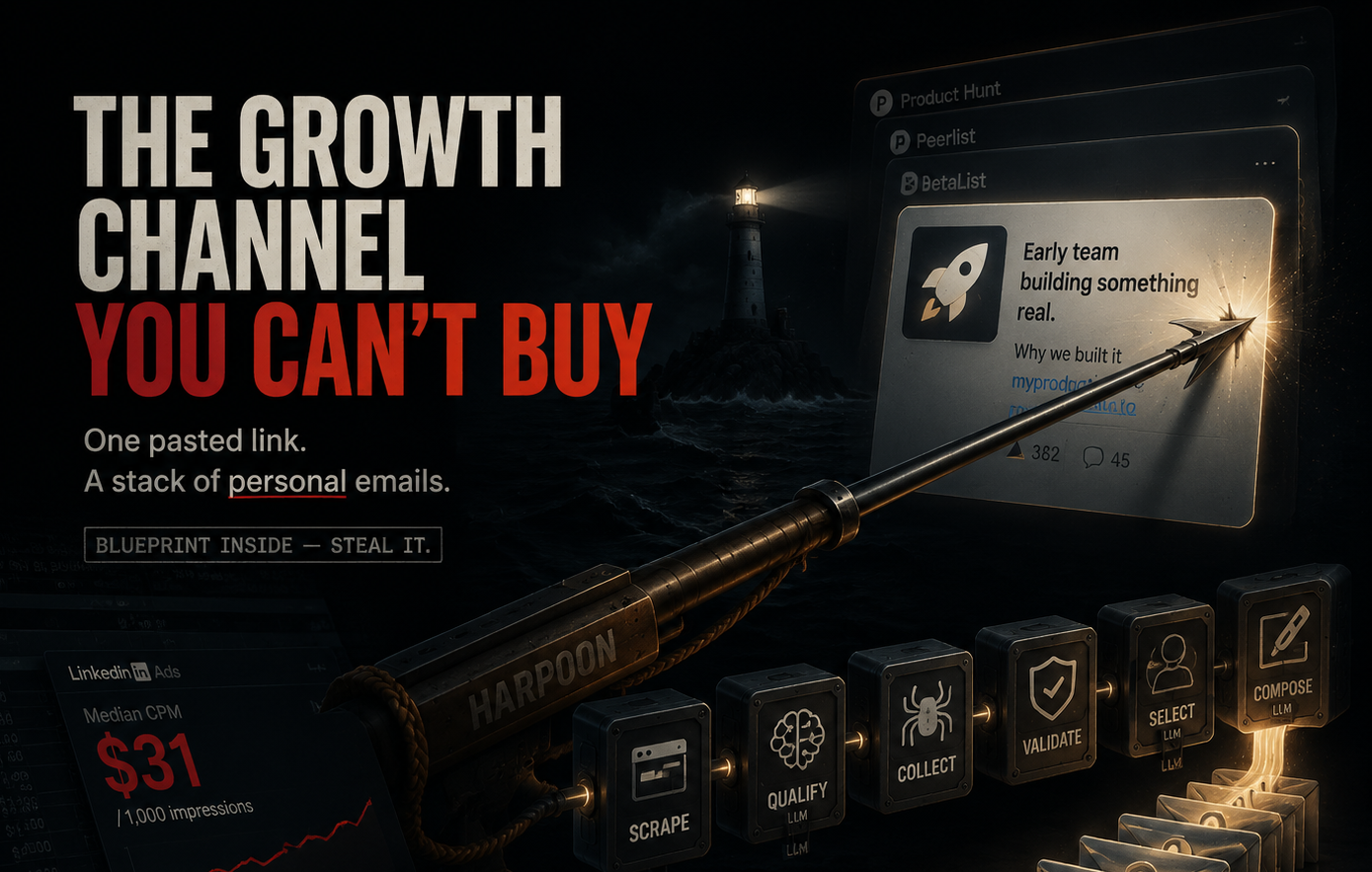
E6: The Growth Channel You Can't Buy

The line under this episode reads $0.00. The season-one war plan, written before I know the ending: 4 bets, real constraints, every result reported with numbers — wins and duds. Place yours.
E5: Zero
Five markers on a flat zero line
That's what a pilot season looks like.
Every episode here drops a marker on the project's revenue graph: you read what the team tried, then you watch what the line did about it.
Ours starts at $0.00 with all five markers on day one. The whole point is what happens to the right of them.
The old studios got one thing right: the people who made the shows got paid while the shows ran. How builders earn here — royalties, not tips.

E4: Royalties
There is no input field for revenue on Indie Valley
Not for founders, not for admins, not for me. It doesn't exist in the database.
Your line comes from your payment processor, read-only — or you don't show a line.
One verified $4.5k beats ten claimed $50k. Journalism vs fan fiction. That's the whole product.
A like costs nothing, which is exactly what it's worth. Why the whole economy here runs on one dollar a month, and what that dollar actually opens.
E3: The Cheapest Form of Respect
The most expensive code I ever shipped worked perfectly
Clean architecture, fast delivery, zero users. We built exactly the wrong thing, brilliantly.
15 years in engineering and the lesson I keep re-learning is the same: speed was never the expensive part. Direction was.
Full story in E01 · Expensive Mistakes — the pilot of the Indie Valley show.
It takes 30 seconds to fake a revenue screenshot — I'll show you. And then what we built so nobody here ever has to trust one again.
E2: Fan Fiction
Indie Valley is live
Real teams building in the open, on revenue lines pulled read-only from their payment processors. Public to everyone, fakeable by no one.
No screenshots, no "trust me" numbers. Stories you can actually learn from, because they actually happened.
Our own line is up there too. It reads $0.00 today. Building it up in public starts now — E01 is out.
Builders: the stage is free. Everyone else: pick a show.
The most expensive code I ever shipped worked perfectly. 15 years of building fast, wrong things — and the bet I'm making so builders stop working in the dark. The line below starts at zero.